

"License Reseller" and "Consulting & Implementation" Partner
One of the most valuable strategic assets in any organisation is its information and knowledge. The way information flows within teams significantly impacts how quickly problems are resolved and how effectively customer issues are addressed. When employees can access the information they need without delay, overall productivity improves and customer satisfaction increases.
ServiceNow’s Knowledge Management module enables this by providing a structured, searchable database supported by strong analytics and a user-friendly interface. In this article, we will explore the essential aspects of ServiceNow Knowledge Management, why it matters, and how DevTools can help you maximise the value of ServiceNow’s Knowledge Management capabilities.
ServiceNow’s Knowledge Management is built on the platform’s One Data Model architecture — a foundational principle that differentiates ServiceNow from fragmented legacy or traditional systems. Knowledge Management works seamlessly with all other ServiceNow modules.
The One Data Model eliminates data silos, enables powerful cross-functional workflows, and delivers complete analytics that span all service operations.
With this unified approach, knowledge is not only stored but actively connected to the people and processes that rely on it. Teams gain a single source of truth that supports consistency, efficiency, and improved outcomes across the organisation.
ServiceNow Knowledge Management operates effectively due to its wide range of essential features.
The ServiceNow platform’s interface allows users to create articles and distribute them across the system. Complex information is easier to understand when enhanced with visual content, code snippets, diagrams, videos, and images.
The knowledge base article management system includes features such as versioning, advanced formatting, and workflow approvals. These ensure content remains accurate, consistent, and well-maintained over time.
The platform interface is designed to be intuitive and easy to navigate. Users can save articles for later reference, apply filters to locate content quickly, and view all available knowledge bases through a central dashboard. These capabilities significantly reduce the time spent searching for information.
Users can organise knowledge base articles using categorisation and tagging, enhancing search functionality and navigation across the platform. By maintaining a logical taxonomy, teams ensure users can quickly find topics relevant to their needs.
ServiceNow tracks article usage through built-in analytics, generating insights into view counts, effectiveness, and common search trends. These insights help identify missing knowledge areas, outdated content, and articles that require immediate updates or improvements.
The system’s features support efficient content creation, refinement, and distribution. When integrated with other ServiceNow modules such as ITSM and CSM, the knowledge base becomes a powerful self-service resource. This reduces ticket volume while enabling both users and support teams to resolve issues more efficiently.
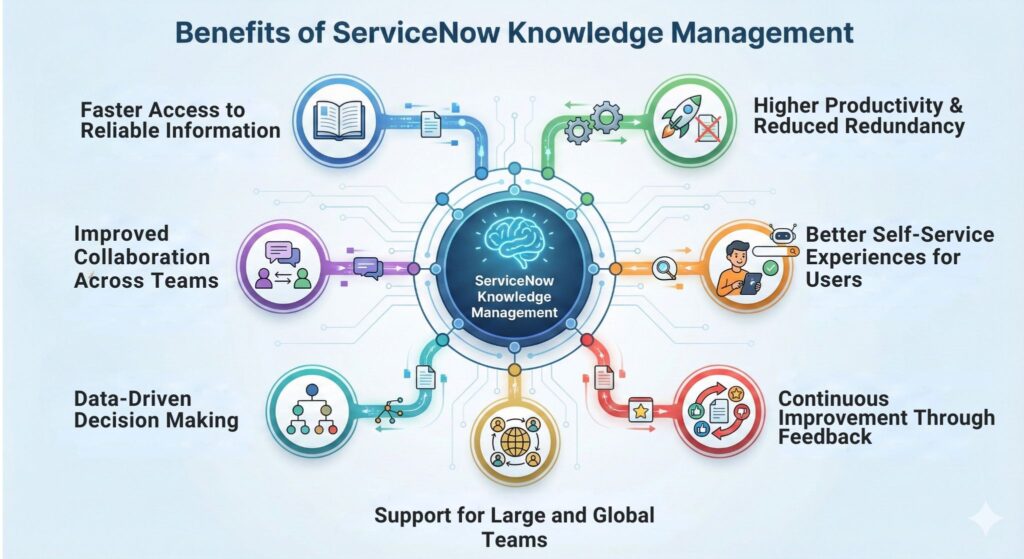
ServiceNow Knowledge Management offers strong operational benefits by making information easier to capture, share, and reuse across the organisation. When employees have quick access to reliable content, teams work faster, customer issues are resolved sooner, and knowledge becomes a strategic asset rather than dispersed information.
The module provides a central, searchable repository where employees can easily locate accurate and approved information. This reduces time spent looking through emails, chats, or outdated folders and helps improve first-contact resolution across IT, HR, and customer service teams.
Standardising knowledge eliminates repetitive work. Teams no longer need to recreate solutions for recurring issues. With consistent, version-controlled articles, everyone works with the most up-to-date information, allowing employees to focus on more valuable, higher-priority tasks.
Knowledge creation and maintenance become collaborative activities. Authors, subject-matter experts, and reviewers can contribute updates, refine content, and ensure that articles reflect accurate organisational expertise. This strengthens communication between departments and supports a culture of continuous learning.
Accessible knowledge empowers employees and customers to resolve common issues on their own. This reduces ticket volumes, improves resolution speed, and increases user satisfaction. When combined with Virtual Agent, knowledge becomes even easier to access through conversational AI.
Usage analytics reveal which articles perform effectively, which require updates, and where knowledge gaps exist. Leaders gain visibility into trends, frequently searched topics, and areas that require new documentation — enabling informed decision-making.
Ratings, comments, and performance dashboards help teams refine the knowledge base. Outdated articles can be retired, high-value content can be highlighted, and new articles can be created as emerging issues or new business processes develop.
Multilingual support and role-based access ensure that the right information is delivered to the right audience, regardless of location. This is particularly valuable for distributed or global enterprises with multiple support functions.
Read: What Is ServiceNow? The AI Platform for Modern Enterprises
A successful knowledge programme requires thoughtful structure, strong governance, and disciplined content practices. The following best practices help organisations build a scalable and high-performing knowledge base.
Define the purpose of each knowledge base, understand user groups, and set up governance roles. Establish detailed workflows for content creation, review, approval, and publishing to maintain accuracy and control.
A well-structured taxonomy — including categories, tags, and naming conventions — ensures content is easy to discover. A logical taxonomy reduces search time and supports long-term content expansion.
Templates promote uniform formatting, clarity, and consistency across all knowledge articles. They guide authors to follow best practices and maintain high-quality content throughout teams.
Knowledge stays relevant when subject-matter experts actively contribute. Involving agents, supervisors, and SMEs ensures articles reflect real operational insights and help reduce knowledge gaps.
Schedule regular content audits, track performance metrics, retire outdated articles, and update content using feedback and analytics. Continuous improvement strengthens the long-term value of your knowledge programme.
ServiceNow Knowledge Management transforms organisational know-how into actionable, searchable content. While simple in concept, it is highly powerful in execution: create accurate articles, route them through controlled workflows, make them discoverable in the flow of work, and continuously improve them through analytics and feedback.
Authors draft articles using pre-built templates that maintain structure, readability, and clarity. Templates ensure consistent formatting and make it easy to include images, step-by-step instructions, or code snippets.
Content moves through configurable approval workflows. Subject-matter experts and managers validate accuracy, compliance, and categorisation before publication. Role-based permissions ensure that only authorised contributors can publish or edit articles.
Once approved, articles are published into one or multiple knowledge bases. Visibility can be restricted or extended to internal teams, specific user roles, customers, or the external public based on organisational governance rules.
Powerful search, contextual help within records, the Service Portal, and Virtual Agent make knowledge easily discoverable at the point of need. Tagging, categorisation, and semantic search improve time-to-resolution and enhance first-contact resolution.
ServiceNow tracks article usage, ratings, and user feedback. Automated alerts flag outdated, underperforming, or aging content for review. Version control preserves article history and enables secure rollbacks when needed.
Integrations with Virtual Agent and ServiceNow AI allow the system to suggest relevant articles during ticket creation, generate drafts from incident resolutions, and highlight knowledge gaps for new content creation.
This lifecycle ensures that knowledge remains current, reliable, and aligned with business processes — turning static information into a dynamic, continuously improving organisational asset.
Fragmented knowledge and disconnected data sources are common organisational challenges. Without a unified knowledge base, employees rely on scattered information, tribal knowledge, and manual searches through documents or emails. This leads to inconsistent responses, longer resolution times, and dissatisfied customers.
ServiceNow Knowledge Management helps resolve multiple key challenges:
The onboarding process becomes more efficient because new employees can access curated knowledge base articles designed for quick learning. This reduces dependency on formal training sessions and accelerates time-to-productivity.
Knowledge base articles empower both support agents and customers to use self-service options, reducing the number of inbound tickets and calls, and easing the workload on support teams.
Information becomes consistent and centralised when all team members access verified, approved content in a single location. Version control and review workflows ensure articles remain updated and accurate.
Categorisation, tagging, and bookmarking features enhance the discoverability of knowledge base articles. Users can find the information they need quickly, without navigating through multiple systems or folders.
The system tracks how users interact with articles. Low engagement or poor ratings highlight content that requires updates, improvements, or complete revision.

Knowledge Management does not operate in isolation. ServiceNow AI agents enhance the knowledge lifecycle by generating and updating articles automatically. For example, an Operational Technology (OT) knowledge-generation agent can produce a new article after an incident is resolved. Similarly, post-incident review agents can create executive summaries with impact analysis.
These capabilities ensure the knowledge base grows continuously without adding manual workload. Looking ahead, trends in agentic AI — such as hyper automation and decision intelligence — will make knowledge ecosystems even more proactive, identifying gaps and recommending relevant content before users request it.
Read: ServiceNow Implementation: Process, Best Practices, and Adaptive Framework
DevTools recognises that a knowledge base is valuable only when it aligns with your organisation’s processes, language, and culture. Our services help ensure your knowledge initiative is strong and sustainable.
We work with stakeholders to develop a clear taxonomy, build an effective hierarchy, and define categories and tags that align with organisational structures. A well-designed taxonomy is essential for intuitive navigation and long-term scalability.
We help implement and configure the ServiceNow Knowledge Management module, establish approval workflows, and integrate it with other ServiceNow applications to ensure a seamless experience.
Our team assists with migrating existing knowledge base articles, removing duplicates, and cleaning up outdated content. We collaborate with customer teams to set up governance processes that maintain long-term content quality.
DevTools supports user training for knowledge managers, authors, and consumers to ensure strong adoption and effective usage of the knowledge base.
We help monitor the adoption rate using native analytics, identify gaps, and coordinate with your team to keep the article content updated.
In an environment where information overload can hinder productivity, ServiceNow’s Knowledge Management module delivers the structure, governance, and analytics required to maintain high-quality content. Features such as article creation and publishing, categorisation and tagging, usage tracking, and intuitive navigation empower employees and customers to self-serve effectively. These capabilities also pave the way for AI-powered automation across the platform.
The result is faster resolutions, improved user experiences, and a culture of continuous learning. DevTools supports organisations in designing, implementing, and optimising knowledge programmes so that knowledge becomes a strategic advantage rather than a bottleneck. Contact DevTools to discover how a modern knowledge programme can transform your organisation.
Knowledge Management (KM) in ServiceNow is a central system that allows organisations to create, organise, store, and share their collective knowledge through structured articles such as solutions, guides, and policies.
Increase user satisfaction: Provide consistent, proven resolutions for customers and employees to improve self-service outcomes.
Promote knowledge sharing: Empower agents to write or automatically generate articles as part of their workflow.
Power continuous improvement: Identify knowledge gaps, create new content, and track governance, usage, and quality trends.
Faster Case Resolution: Agents can quickly locate relevant knowledge articles within their incident, problem, or case workflows.
Consistent and Accurate Responses: Knowledge articles ensure all agents provide standardised and reliable information.
Reduced Escalations: Easily accessible articles help agents resolve common issues without escalating tickets.
Self-Service Enablement: Users can resolve issues independently by searching the knowledge base, reducing support requests and increasing empowerment.
A knowledge base (KB) is a central collection of documentation that includes FAQs, guides, and troubleshooting steps. Its purpose is to help users find solutions independently and reduce the number of incoming support requests.
IT Service Management (ITSM): ITSM enables self-service and faster ticket resolution through a unified knowledge base.
Customer Service Management (CSM): Provides customer- and agent-facing knowledge portals for seamless support.
HR Service Delivery (HRSD): HRSD delivers HR policies and articles directly to employees.
Field Service Management (FSM): FSM helps field teams diagnose issues quickly using mobile knowledge access.
No. ServiceNow Knowledge Management is included with ITSM, CSM, and HR modules, making it accessible and beneficial for organisations of all sizes.

Pramodh Kumar M is a Solutions Architect at DevTools with over 6 years of specialized experience in DevSecOps and enterprise IT solutions. He holds multiple advanced certifications, including Certified Kubernetes Security Specialist (CKS), GitHub Advanced Security, and Azure Solutions Architect Expert. Pramodh specializes in Agile, Cloud & DevOps toolchain implementations, with extensive hands-on experience helping enterprises with digital transformation initiatives. His expertise extends to ServiceNow implementation and support. He is passionate about sharing practical insights on Cloud, DevOps, Automation, and modern IT operations.