

"License Reseller" and "Consulting & Implementation" Partner

Field service operations are often the face of your brand. The interaction between customers and your organization determines their assessment of your company because technicians perform telecom equipment installation and manufacturing machinery repair, and home medical service delivery. Many organizations continue using traditional manual dispatching methods together with paper-based forms and separate systems, which result in delayed appointments and extra truck visits, and unhappy customers.
ServiceNow Field Service Management (FSM) revolutionizes field operations through its combination of artificial intelligence, data analytics, and workflow management, which enables proactive and predictive service delivery. The article explains FSM by describing its operation, presenting its advantages and disadvantages, and providing guidelines for successful deployment. We also explain how DevTools helps organizations optimize field service and customer satisfaction.
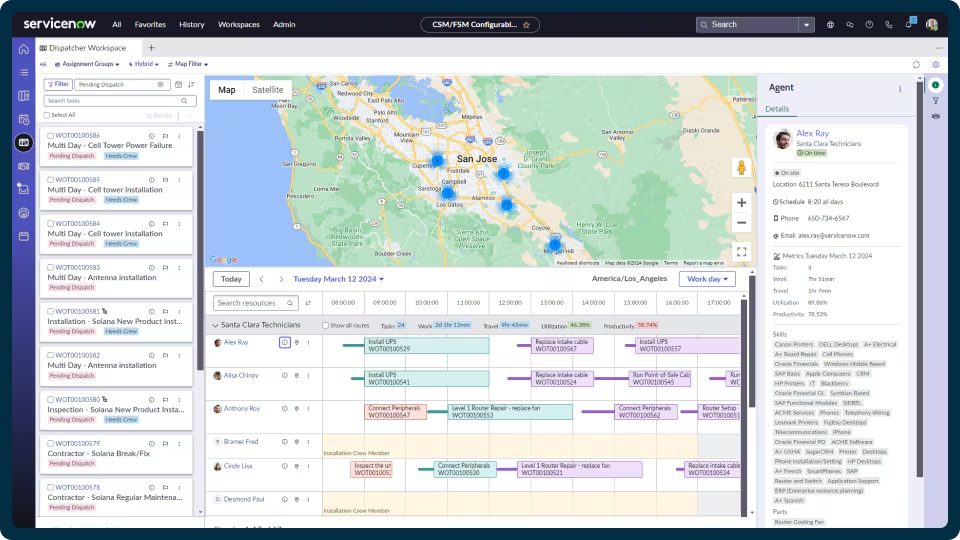
The ServiceNow application FSM enables users to track fieldwork activities from initial intake through work-order creation to scheduling and dispatching and mobile execution, and final reporting. Built on the same platform as Customer Service Management, FSM shares a common CRM data model and prebuilt integrations.
The system produces work orders automatically when customers or internal teams submit service requests, while it determines necessary parts and personnel and assigns technicians for work. The mobile application contains playbooks that guide technicians through their work while enabling them to take photos and track their progress, and finish their tasks outside the office.
The system updates records through FSM after work completion while it executes billing operations and inventory management, and stores customer feedback information. Organizations use AI-powered scheduling and dispatch systems to distribute resources efficiently through time-based assignments and operational performance analytics.

FSM integrates front‑office interactions with back‑office fulfillment.
ServiceNow FSM delivers major organizational value to the entire organization throughout its entire operational scope.
Organizations achieve reduced costs and increased revenue through automated scheduling and dispatch systems, which optimize technician routes to minimize travel time and increase daily work completion rates. AI‑driven field service reduces unneeded visits and improves capacity utilization. ServiceNow’s FSM customers have reported up to a 310 % return on investment.
Customers can schedule appointments through self‑service portals, track technician arrival, and receive real‑time updates. The system performs intelligent scheduling and predictive maintenance to minimize delays and prevent patients from missing their scheduled appointments.
The system enhances technician work efficiency and safety through its mobile playbook system, which guides users through each step. Smart Assessment enables field data collection through visual guidance and conditional logic, which simplifies the process. The advanced task dependencies help organizations create proper work sequences, which minimize the need for additional work.
The capacity console, introduced in the Yokohama release, provides intraday scheduling tools and visualizes allocated versus used capacity, allowing dispatchers to identify under or overbooked scenarios and reassign work. Enhanced territory filters give dispatchers a hierarchical view of regions and resources.
FSM uses AI and real‑time data to monitor asset health, recommend maintenance, and prevent failures. Appointment booking slot recommendations suggest optimal times for customers based on technician availability and location.
FSM’s integration with CSM and Sales allows organizations to service, sell, and fulfill on one platform. Customers can request service, receive quotes, and schedule installations without leaving the portal.
Field service organizations often struggle with manual processes, siloed systems, a lack of real‑time visibility, and staffing inefficiencies. The 2025 ISG Buyers Guide highlights that many organizations still rely on manual planning and scheduling, leading to wasted time and inconsistent service. Legacy solutions have clunky interfaces that frustrate dispatchers and technicians. ServiceNow FSM addresses these challenges by uniting AI, data, and workflows on one platform. AI agents plan work, schedule, and dispatch technicians autonomously, and enable proactive service. The platform’s usability ensures that dispatchers have all the necessary information in one workspace and technicians receive mobile playbooks.
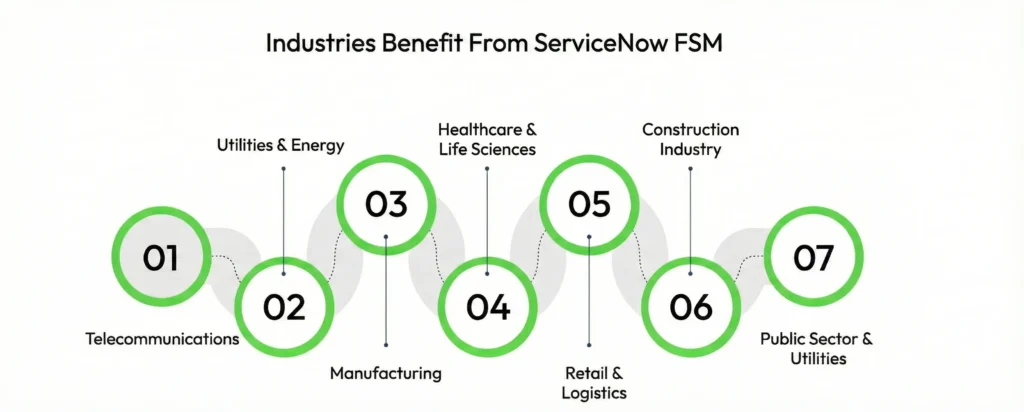
ServiceNow FSM is industry-agnostic by design, but its value becomes especially tangible in sectors where assets, people, and SLAs must be coordinated across locations and time. Below are the primary industries that realize immediate ROI and strategic value from FSM — with specific examples of how they use the platform.
Telecom providers rely on FSM to manage network rollouts, field repairs, and last-mile installations. Intelligent scheduling reduces truck rolls, while mobile playbooks ensure technicians have site history, required parts, and safety checks — increasing first-time fix rates and lowering customer churn.
For utilities, outages and regulatory compliance are mission-critical. FSM integrates with SCADA/IoT inputs to convert alerts into prioritized work orders, dispatch qualified crews quickly, and capture auditable field data. The result: faster restoration, safer crews, and standardized regulatory reporting.
Manufacturers use FSM to keep production lines running. FSM coordinates preventive maintenance, warranty repairs, and vendor/contractor work so equipment uptime improves and unplanned downtime drops. Integration with ERP and asset systems keeps parts synchronized with job demands.
Medical devices and imaging equipment require precise, timely maintenance. FSM delivers compliance-ready workflows, technician mobile guidance, and audit trails that help hospitals keep critical equipment certified and available — directly supporting patient safety.
Retailers and logistics operators use FSM for in-store installations, POS maintenance, and delivery-adjacent services. Real-time appointment booking, ETA visibility, and integrated order/asset information create smoother customer experiences and reduce repeat visits.
Complex projects and dispersed sites demand tight coordination. FSM handles multi-crew assignments, subcontractor orchestration, and site inspections — ensuring the right skills and parts are dispatched, and projects stay on schedule.
Government and municipal services benefit from FSM’s traceable workflows and compliance controls for public safety, inspections, and infrastructure repair — enabling transparent service delivery and auditable performance.
The system operates with flexibility, which enables its use throughout different business sectors.

AI is embedded in every layer of ServiceNow FSM.
The Yokohama release introduced several AI-powered enhancements:
These innovations allow organizations to focus on high-value work and deliver faster, more comprehensive service.
Implementing FSM successfully requires a structured approach:
Implementing FSM can be challenging. DevTools helps organizations streamline field operations by configuring FSM modules, designing intelligent scheduling, and building integrations with asset, inventory, and ERP systems.
We are a leading ServiceNow partner, specializing in:
Our Approach:
Post-Implementation Support:
We provide training and managed services to ensure continuous improvement, helping organizations maintain efficiency, enhance customer satisfaction, and maximize the value of their ServiceNow FSM investment.
Field service is more than fixing things—it’s about delivering exceptional customer experiences. ServiceNow FSM unites AI, data, and workflows to reduce costs, improve scheduling, empower technicians, and provide proactive service. The latest innovations, such as Smart Assessment, capacity console, and appointment recommendations, help organizations focus on high‑value work and respond to customer needs faster. When implemented with the guidance of a partner like DevTools, FSM becomes a strategic differentiator and revenue generator. Investing in modern field service now will prepare your organization for the predictive, AI‑driven future.
It is a ServiceNow application that manages the entire lifecycle of fieldwork from work‑order creation to scheduling, dispatch, mobile execution, and closure—on a unified platform.
AI optimizes schedules based on skills, location, availability, and service‑level commitments. The capacity console visualizes resource utilization, allowing dispatchers to adjust assignments in real time.
Yes. Appointment booking slot recommendations suggest optimal appointment times to minimize travel and avoid overbooking. Predictive maintenance alerts create work orders before failures occur.
Dashboards and analytics show the real‑time status of work orders, technician performance, parts usage, and customer satisfaction. Enhanced territory filters allow dispatchers to view resources across multiple regional hierarchies.
Customers can schedule appointments, track technicians, and receive real‑time updates through self‑service portals. Integrated workflows and AI reduce delays, increase first‑time fix rate, and ensure proactive maintenance.

Pramodh Kumar M is a Solutions Architect at DevTools with over 6 years of specialized experience in DevSecOps and enterprise IT solutions. He holds multiple advanced certifications, including Certified Kubernetes Security Specialist (CKS), GitHub Advanced Security, and Azure Solutions Architect Expert. Pramodh specializes in Agile, Cloud & DevOps toolchain implementations, with extensive hands-on experience helping enterprises with digital transformation initiatives. His expertise extends to ServiceNow implementation and support. He is passionate about sharing practical insights on Cloud, DevOps, Automation, and modern IT operations.