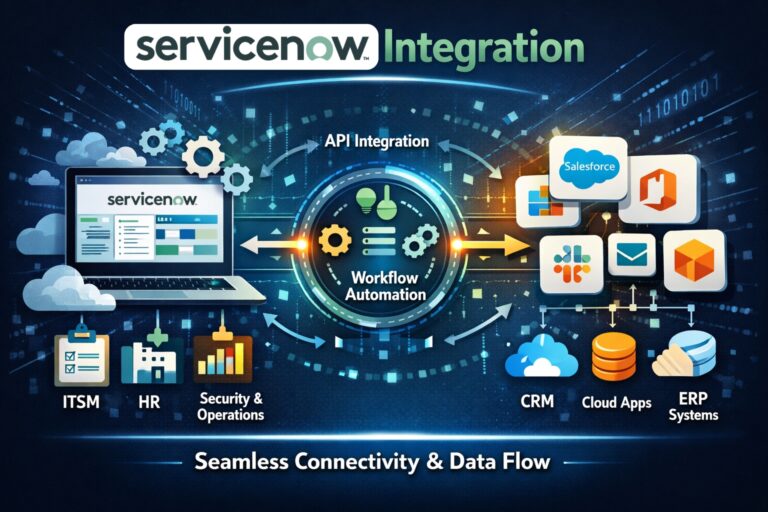

"License Reseller" and "Consulting & Implementation" Partner

The pace of business change has never been faster. IT leaders and business executives need to adapt quickly, deliver new services and automate processes without being bogged down by traditional development cycles. ServiceNow low code development solves this challenge by providing visual tools, reusable components and AI‑powered assistance that enable developers of any skill level to build sophisticated applications.
This article explains how low code works on the ServiceNow AI Platform, the tools you can use, the benefits it brings and how a trusted partner like DevTools can accelerate your journey.
In the past, building enterprise applications required deep programming expertise and long development cycles. Business teams often had to wait months for new functionality, leading to workarounds in spreadsheets or shadow IT. Low‑code platforms democratise development by offering drag‑and‑drop interfaces, prebuilt components and guided development.
ServiceNow combines low‑code tools with its AI platform, workflow engine and data model, allowing organizations to build apps that are secure, scalable and integrated by default.
Low code in ServiceNow is a way to build and customize apps using visual tools and configuration instead of traditional programming. ServiceNow defines low‑code as an approach to rapidly creating applications with minimal programming effort.
According to ServiceNow’s learning article, low‑code platforms use visual modelling and reusable components so that non‑technical users can create apps while professional developers can accelerate complex tasks.
ServiceNow’s low‑code approach sits between no‑code (for simple, consumer‑grade apps) and full‑stack development (which requires extensive coding).
Low‑code tools empower both citizen developers and professional developers to work in the same environment, creating enterprise‑grade applications that scale across departments.
On the Now Platform, low‑code development is built into the App Engine. The platform provides a unified data model, workflow engine and UI framework. Developers use a visual interface to define data tables, design forms, build flows and create pages.
Prebuilt templates and components allow them to assemble functionality quickly. In addition, ServiceNow integrates AI directly into the low‑code experience.
For example, Now Assist for Creator uses generative AI to convert natural language into code or flows, auto‑complete script logic and generate entire applications based on written requirements. This fusion of AI and low‑code accelerates development while maintaining quality and security.
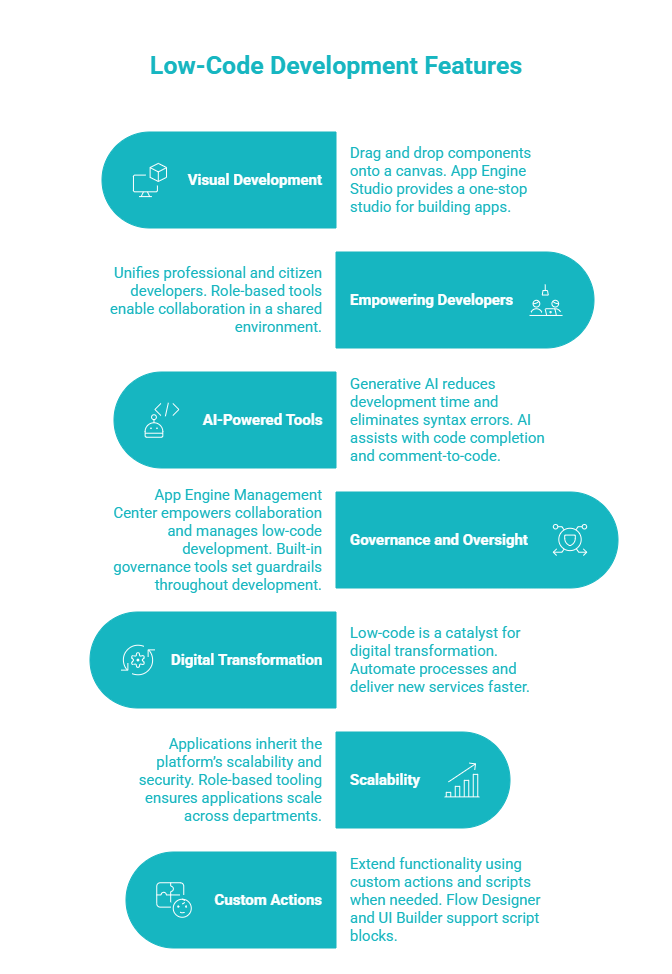
Low code is fundamentally visual. Instead of writing lengthy scripts, developers drag components onto a canvas. ServiceNow’s App Engine Studio (AES) provides a one‑stop studio for building apps.
The product page notes that AES gives citizen developers a collaborative place to work with inline dashboards, making it easy to design and iterate on UIs. Visual development extends to data modelling (using Table Builder), flow creation (using Flow Designer) and page design (using UI Builder).
Low‑code is not just for non‑technical users; it unifies professional and citizen developers. ServiceNow’s low‑code platform allows both groups to collaborate while still adhering to governance. Role‑based tools enable admins, platform owners and business technologists to work in a shared environment.
Delegated development lets business technologists build apps within controlled boundaries, while professional developers can extend functionality with scripted components or APIs when needed.
Generative AI is embedded into ServiceNow’s low‑code offering. The Now Assist for Creator data sheet explains that AI‑powered app, playbook, flow and code generation significantly reduces development time, converts natural‑language comments into workable apps and eliminates syntax errors. AI also assists with code completion and comment‑to‑code, enabling developers to focus on business logic rather than syntax.
Scaling low‑code requires guardrails. ServiceNow’s App Engine Management Center empowers business and IT to collaborate, manage and govern low‑code development. Administrators can track requests, deployments and app usage, ensuring that citizen developers follow standards.
Built‑in governance tools set guardrails throughout development based on tested AI models and allow platform owners to enforce security policies.
Low‑code is a catalyst for digital transformation. By empowering domain experts to automate processes, organizations can digitize manual workflows and deliver new services faster.
ServiceNow emphasizes that low‑code accelerates delivery, increases agility, reduces costs and maintains governance. When combined with the Now Platform’s workflow engine and AI, low‑code drives end‑to‑end automation across IT, HR, customer service and beyond.
Applications built with ServiceNow’s low‑code tools inherit the platform’s scalability and security. The App Engine leverages the underlying Now Platform, which is designed for enterprise‑grade workloads and compliance. Role‑based tooling ensures that applications scale across departments and support hundreds or thousands of users. Prebuilt connectors and Integration Hub further scale apps by connecting them to external systems.
While low‑code minimizes scripting, developers can extend functionality using custom actions and scripts when needed. Flow Designer and UI Builder support script blocks, and Integration Hub offers advanced actions for complex integrations. This flexibility allows developers to meet unique requirements without leaving the low‑code environment.
AES is the primary low‑code development environment. The product page describes AES as a unified, intuitive studio that enables users to build apps with visual design tools, inline dashboards and shareable templates. AES includes Table Builder for data modelling, App Templates for quick starts and integration with Flow Designer.
App Engine Management Center (AEMC) is a governance and management hub. The App Engine product page explains that AEMC empowers business and IT to collaborate, manage and govern low‑code app development.
It provides visibility into app requests, usage and deployment status. Role‑based dashboards ensure that admins, platform owners and business technologists can monitor progress and enforce standards.
Now Assist for Creator brings generative AI to low‑code development. The data sheet notes that Now Assist provides app generation, playbook generation, flow generation and code generation features.
It converts natural‑language comments into workable apps and automated flows, eliminates syntax errors and increases developer productivity. This tool is particularly powerful for accelerating prototyping and reducing time‑to‑value.
Flow Designer is ServiceNow’s visual workflow builder. It allows users to define trigger conditions, drag actions and design decision logic. Flow Designer integrates with Integration Hub spokes to connect to external systems. According to the App Engine product page, Flow Designer automates business processes as digital workflows across departments and systems.
UI Builder provides a drag‑and‑drop interface for creating workspace pages and portal experiences. Developers can assemble components, configure data sources, and create responsive, mobile‑friendly UIs without coding. UI Builder integrates with the Now Experience Design System, ensuring a consistent look and feel.
ServiceNow Studio (also called Studio IDE) is an integrated development environment for more advanced development. It provides a code editor, source control integration and application scaffolding. Developers can transition seamlessly between low‑code design and full‑stack coding within Studio.

Low‑code on the Now Platform delivers significant benefits:
Also read:- Low Code vs No Code: Understanding Modern App Development
Low‑code can be applied across many domains:
While low‑code offers many advantages, organizations should be aware of potential challenges:
Low‑code development is most effective when paired with expert guidance. DevTools is a ServiceNow partner with extensive experience implementing low‑code solutions. We help customers:
By partnering with DevTools, organizations can accelerate digital transformation, reduce development bottlenecks and maximize their return on the ServiceNow AI Platform.
Low‑code development in ServiceNow is a powerful way to create enterprise applications quickly without sacrificing quality or governance. The platform combines visual tools, AI‑powered assistance, prebuilt components and robust governance to help organizations innovate rapidly.
As digital transformation accelerates, the need for easy‑to‑build, scalable applications becomes critical. ServiceNow’s low‑code capabilities – comprising App Engine Studio, App Engine Management Center, Now Assist for Creator, Flow Designer, UI Builder and ServiceNow Studio – provide a complete toolkit for building, automating and scaling workflows.
Working with a knowledgeable partner like DevTools ensures that your low‑code initiatives deliver real value, align with strategic objectives and adhere to best practices.
It is an approach to building applications on the Now Platform using visual tools, reusable components and minimal code. It empowers both citizen and professional developers.
Low‑code allows users to build apps with minimal coding while still having the option to extend functionality with scripts, whereas no‑code provides only configuration options and may lead to shadow IT when used for complex enterprise applications.
Anyone from business technologists to professional developers. The platform provides role‑based tools and governance so that citizen developers can create apps safely while IT maintains control.
You can build service request apps, HR onboarding workflows, case management solutions, field service apps, compliance trackers and more. Essentially, any workflow that requires data capture, automation and integration is a candidate for low‑code.
Yes. Apps built on the Now Platform inherit enterprise‑grade scalability, security and compliance. App Engine Management Center and governance tools ensure that low‑code apps scale safely across departments.
DevTools provides end‑to‑end low‑code services, including process analysis, app design, integration, governance setup, training and ongoing support. We help clients build applications faster while adhering to best practices.
Our experts leverage App Engine Studio, Flow Designer and Now Assist to accelerate development, implement reusable templates and integrate external systems. We also provide coaching to citizen developers.
Yes. DevTools designs and builds apps and also connects them to ERP, CRM, HR and DevOps systems using Integration Hub spokes.
Absolutely. We tailor apps to your processes, incorporate custom logic and build bespoke components when necessary while ensuring compliance with governance policies.

Pramodh Kumar M is a Solutions Architect at DevTools with over 6 years of specialized experience in DevSecOps and enterprise IT solutions. He holds multiple advanced certifications, including Certified Kubernetes Security Specialist (CKS), GitHub Advanced Security, and Azure Solutions Architect Expert. Pramodh specializes in Agile, Cloud & DevOps toolchain implementations, with extensive hands-on experience helping enterprises with digital transformation initiatives. His expertise extends to ServiceNow implementation and support. He is passionate about sharing practical insights on Cloud, DevOps, Automation, and modern IT operations.